The Rundown Newsletter
View Results
Ian Campbell | June 22, 2026
Managing race registrations with google forms and spreadsheets creates unnecessary work.
Participant edits.
Waivers.
Bib assignments.
Payment tracking.
Confirmation emails.
As registrations grow, manual processes become harder to manage and increase the risk of mistakes.
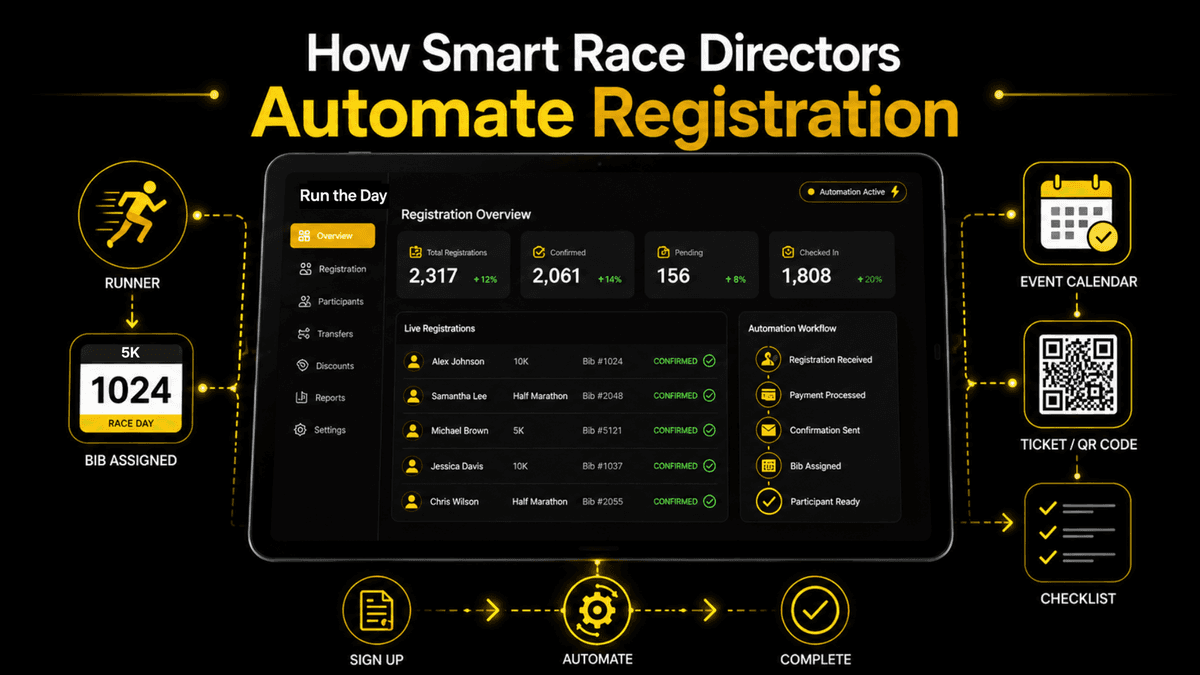
Smart race directors automate registration workflows to save time, reduce errors, and improve the runner experience.
Automation does not remove control.
It removes repetitive work.
This guide explains how race registration automation works, what should be automated, and how integrated systems help races operate more efficiently.
If you're still in the planning stages, start with our guide on how to organize a race before building your registration process.
Race directors automate registration using race registration software that handles participant data, payment collection, email receipts, waivers, and communication. This reduces manual work, improves data accuracy, and creates a smoother race-day experience.
Race registration automation refers to software handling repetitive administrative tasks automatically.
Examples include:
Instead of manually sending confirmations or updating spreadsheets, the software performs these tasks automatically.
The result is less administrative work and fewer opportunities for human error.
Key takeaway: Automation removes repetitive work—not the need for an organizer to manage the event.
Many organizers first explore automation while researching easy race registration software for 5k designed specifically for races rather than generic event systems.
Many first-time race directors still manage registrations manually.
At first, spreadsheets may seem manageable.
As registrations increase, problems begin to appear:
A simple typo in participant data can create problems throughout the entire event lifecycle.
Many of these challenges appear in our guide to first-time race director mistakes, where registration management is one of the most common issues new organizers face.
Strong planning and systems can prevent these problems before they happen. A detailed race planning checklist can identify operational gaps long before race day.
The best automation projects start with repetitive tasks.
Most races automate:
These tasks require time but rarely require human decision-making.
Automating the tasks helps race directors save time.
Some races also automate sponsor collections using custom payment links for races, eliminating the need to manually track checks, invoices, and payment follow-ups.
As race data becomes more valuable, organizers increasingly use AI race analytics to better understand registration trends and participant behavior.
Small automations can save large amounts of time.
Download our free Race Planning Checklist and get a step-by-step guide covering registration, volunteers, sponsors, timing, promotion, and race-day operations.
| Task | Manual Process | Automated Process |
| Registration confirmation | Sent manually | Instant email receipt |
| Payment tracking | Spreadsheet updates | Real-time syncing |
| Waiver collection | Paper forms | Digital collection |
| Bib assignment | Spreadsheets with labels | Streamlined mobile app |
| Participant communication | Individual emails | Scheduled campaigns |
| Data accuracy | Higher error risk | Cleaner participant data |
| Race-day setup | More manual work | Faster preparation |
Participants expect convenience.
They expect immediate confirmation.
They expect mobile-friendly registration.
They expect clear communication.
Automation helps races deliver all of these expectations.
Benefits include:
A smoother registration experience often leads to stronger conversion rates and helps increase race registrations over time.
Many races also improve registration accessibility by using QR codes for race registration on flyers, posters, sponsor locations, and social media graphics.
When registration becomes easier, more runners complete the signup process.
Many race-day problems actually begin weeks before race day.
Incomplete participant information.
Missing waivers.
Incorrect bib assignments.
Last-minute data changes.
These issues often result from manual processes.
Automation helps reduce:
Race directors often discover that stress on race day is caused by poor data management rather than race-day execution itself.
Many of these challenges are discussed in our guide to prevent common race-day problems and chaos.
Key takeaway: Most race-day stress starts before race day.
Many race directors wonder whether automation is necessary.
Common signs include:
If any of these situations sound familiar, automation often provides immediate operational improvements.
The goal is not to add complexity.
The goal is to simplify race management.
One of the biggest operational challenges for race directors is keeping registration data aligned with timing results.
Disconnected systems often create:
Integrated systems improve:
Registration and timing work best when participant data flows seamlessly from signup through results.
Race directors deciding on the best timing operations for their event should understand the fundamentals of how to time a 5K to get an appreciation for why accurate participant data is critical.
When registration and timing work together, race-day execution becomes significantly easier.
Automation is powerful, but it should remain simple.
Common mistakes include:
Every additional field creates friction.
Only collect information you truly need.
Using separate systems for registration, communication, payments, and timing often creates more work.
Automation should improve communication, not overwhelm participants.
Most runners register using mobile devices.
Registration must remain easy-to-use on phones and tablets.
Fix: Keep automation simple, user-friendly, and focused on participant experience.
Not all registration systems provide the same value.
Look for:
The best platforms also provide a professional race website.
Many organizers start by evaluating options for a free race website for 5K events before investing in additional functionality.
A one-stop-shop solution often creates fewer operational challenges than stitching together multiple systems.
Smaller races often assume automation is only useful for large events.
That is not true.
Automation helps small races:
Community races, school events, and nonprofit fundraisers frequently benefit the most because they often operate with limited staff and volunteer resources.
This is one reason why many small races choose Run The Day over RunSignup when evaluating software options.
Even simple automation can dramatically improve operational efficiency.
Run The Day helps automate:
By combining these functions into a one-stop-shop platform, race directors can spend less time managing software and more time growing their events.
Many organizers moving away from older systems are also comparing Run The Day vs RaceWire as they evaluate more modern, easy-to-use race management solutions.
The goal is simple:
Reduce manual work.
Improve accuracy.
Create smoother race-day operations.
Race registration automation uses software to automatically manage tasks such as payments, confirmations, waivers, participant communication, and registration updates.
Yes. Small races often benefit the most because automation reduces administrative workload and improves efficiency.
Yes. Cleaner participant data and integrated systems help reduce delays, confusion, and operational issues.
Start with registration confirmations, payment tracking, waiver collection, and participant communication.
Usually yes. Easier registration experiences typically increase completed registrations and reduce abandonment.
Smart race directors automate repetitive tasks so they can focus on running better events.
Automation helps reduce:
The goal is not more technology.
The goal is smoother operations and better race experiences.
Whether you're organizing your first event or managing an established race, investing in the right systems can make every aspect of race management easier.
Planning a Local 5K?
Run The Day helps race directors automate registration, simplify timing, improve participant communication, and manage race-day operations through an easy-to-use, one-stop-shop platform—so you can spend less time fixing problems and more time growing your event.