The Rundown Newsletter
View Results
Ian Campbell | May 4, 2026
If you're planning a 5K for the first time, you've probably noticed that not all races look the same.
Some races exist to raise money for a cause. Others exist to get people off the couch and into a crowd covered in colored powder. Both involve a start line, a finish line, and a bunch of people moving 3.1 miles. But how they get organized, funded, and promoted are completely different.
This post breaks down the two most common types of 5K events — the charity 5K and the community fun race — so you can figure out which one fits what you're trying to do.
Charity 5K vs Fun Run: Quick Answer
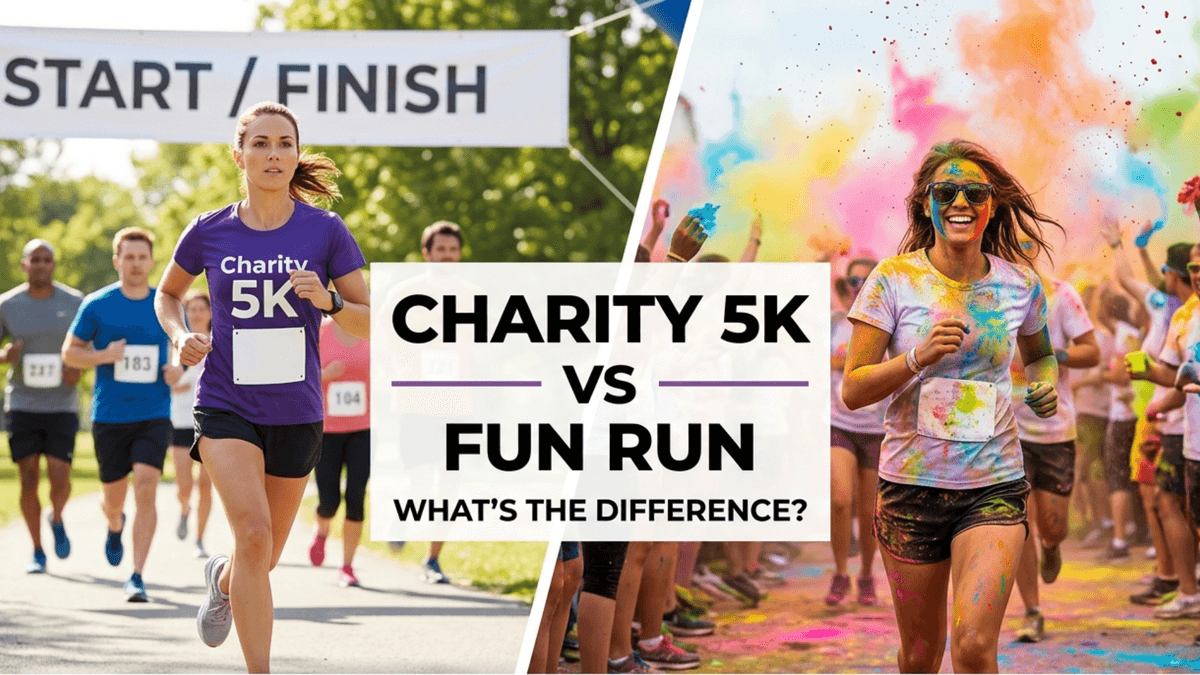
A charity 5K is designed to raise money and awareness for a cause, while a fun run focuses on creating an enjoyable, social experience for participants. The main difference is purpose—mission vs experience.
A charity 5K is a race built around a cause. Cancer research, scholarship funds, veterans' services, local food banks — the cause is the reason the race exists.
The race itself matters, but it's the vehicle, not the destination. Everything from the marketing to the t-shirt design to the post-race speeches is tied to the mission. Participants register because they want to support the cause. Some of them will walk. Some of them have never done a 5K before. That's the point. The barrier to entry is low because the goal is participation, not performance.
Here's what typically defines a charity 5K:
A charity 5K doesn't need to be a world-class running event. It needs to connect people to a purpose and make it easy for them to show up and contribute.
If you're planning your first event, this fits into the broader category of different race formats—here’s a full breakdown of types of 5K races to help you decide what works best for your community.
A community fun race (sometimes just called a "fun 5K") is an event designed around the experience. Think color runs, glow runs, bubble runs, themed costume races, or obstacle-style 5Ks.
The goal isn't to raise money for a specific cause. The goal is to create something that gets people outside, moving, and having a good time together. These events are professionally produced and put a lot of effort into the look, feel, and energy of race day.
Here's what typically defines a community fun race:
A community fun race lives or dies on the participant's experience. If people don't have a great time, they won't come back next year and they won't tell their friends.
Fun runs are just one of many formats you can choose from. If you're still exploring options, check out our guide on how to organize race from start to finish.
Choosing between a charity 5K and a fun run is just the start. This free 5K race planning checklist helps you stay organized, avoid common mistakes, and run a smooth, successful event.
These two types of events share some logistics — you still need a course, permits, volunteers, registration, and timing — but they differ in some important ways.
| Charity 5K | Community Fun Race | |
| Why the race exists | The cause. The race is the vehicle for raising money and awareness. | The experience. The race is the product. |
| How you market it | Lead with the mission. "Run to fight childhood cancer." "Walk in memory of Officer Davis." The emotional connection drives signups. | Lead with the experience. "Get covered in color." "Run under the lights." The promise of a good time fills the registration page. |
| Where the money goes | A significant portion of revenue (often 70-100% after expenses) goes to the cause. Participants expect that. | Revenue covers event production costs and generates profit for the organizer. Participants expect a polished experience in return. |
| Who shows up | People connected to the cause — families, coworkers, support networks. Many aren't regular runners. | People looking for a weekend activity — friend groups, couples, people who saw the event on social media. |
| What success looks like | Dollars raised, awareness generated, and people who felt connected to the cause. |
Attendance, participant satisfaction, social media buzz, and repeat registration. |
A charity 5K focuses on fundraising and awareness for a cause, while a fun run focuses on participant experience and entertainment. The main difference is purpose—mission vs experience.
Yes—and many of the most successful events do exactly that.
You can create a high-energy, themed experience while still supporting a meaningful cause. For example:
The key is clarity.
Participants should immediately understand:
Avoid trying to position both equally. When messaging becomes unclear, registrations drop because people don’t fully understand what they’re signing up for.
Choosing the wrong format—or mixing the two incorrectly—can impact your event’s success. Here are the most common mistakes first-time organizers make:
When you split focus between fundraising and experience, your messaging becomes unclear. Participants need a clear reason to sign up.
Fun runs often require:
Without proper investment, the experience falls flat.
For charity races, participants expect clarity. If donation percentages aren’t clear, it can reduce trust and registrations.
Just because color runs are popular doesn’t mean they fit your audience. Always consider what your local community actually wants.
If you're starting from scratch, ask yourself a few questions:
Do you have a specific cause you're trying to support?
If yes, start with a charity 5K. The cause will be your strongest marketing tool and your reason for getting people to say yes.
Do you want to create a recurring event that grows year over year?
Both can grow, but community fun races tend to scale faster because the experience is the product. You're not dependent on cause fatigue.
What's your budget?
Charity 5Ks can be executed on a lean budget because participants are forgiving when they know the money is going to a good cause. Community fun races often require more upfront investment in production — stages, lighting, supplies, entertainment — because the experience is the expectation.
Who's on your team?
Charity 5Ks are often organized by volunteers who are passionate about the cause but may not have event experience. Community fun races benefit from people who understand event production and logistics.
What does your community need?
Sometimes the answer is obvious. A town that just lost a beloved teacher needs a memorial run. A neighborhood that doesn't have much going on during the summer needs a Saturday morning event that gives people a reason to get together.
Not sure where to begin? Start with a simple planning framework using our complete 5K race planning checklist to map out permits, logistics, and timelines.
Q1: What is the difference between a charity 5K and a fun run?
A charity 5K is organized to raise money and awareness for a specific cause like cancer research, education, or a memorial fund. A fun run (or community fun race) is organized around the participant experience — think color runs, glow runs, or themed costume races. The main difference is purpose: one leads with a mission, the other leads with the event itself.
Q2: Can a fun run also raise money for charity?
Yes. Many organizers combine both by running a fun, themed event and donating a portion of the proceeds to a cause. The key is being upfront about which is the primary focus so participants know what they're signing up for.
Q3: Which type of 5K is easier to organize for a first-time race director?
Charity 5Ks are generally easier to start with a smaller budget because participants are forgiving when they know the money supports a good cause. Community fun races usually require more upfront investment in production — lighting, supplies, entertainment — because the experience is what participants are paying for.
Q4: How much does it cost to organize a charity 5K vs a fun run?
Charity 5Ks can often be organized on a smaller budget since participants are motivated by the cause. Fun runs usually require higher upfront investment for production, entertainment, and themed elements.
Q5: Which type of 5K attracts more participants?
Fun runs often attract larger crowds because they appeal to a broader audience looking for a social experience. However, charity 5Ks can see strong participation when the cause resonates deeply with the community.
A charity 5K and a community fun race are two different tools. One raises money and rallies people around a mission. The other gets people active and builds community through a shared experience.
Neither is better than the other. The right one depends on what you're trying to accomplish.
If you're a nonprofit, school, or foundation — the charity 5K is probably your starting point. If you're a running club, township, or event company looking to create something people talk about — the community fun race might be your move.
Either way, the hardest part isn't choosing the type. It's getting started. Pick one, plan it, and put people on a start line. Everything else comes after that.
Ready to Start Planning Your 5K?
Whether you're organizing a charity 5K or a fun run, having the right tools can make all the difference. From online registration to race-day timing, the right setup ensures a smooth experience for both organizers and participants.