The Rundown Newsletter
View Results
Ian Campbell | September 15, 2026
If you've ever looked at race results and wondered why your gun time and chip time are different, you're not alone.
The difference between gun time and chip time comes down to when your race clock starts.
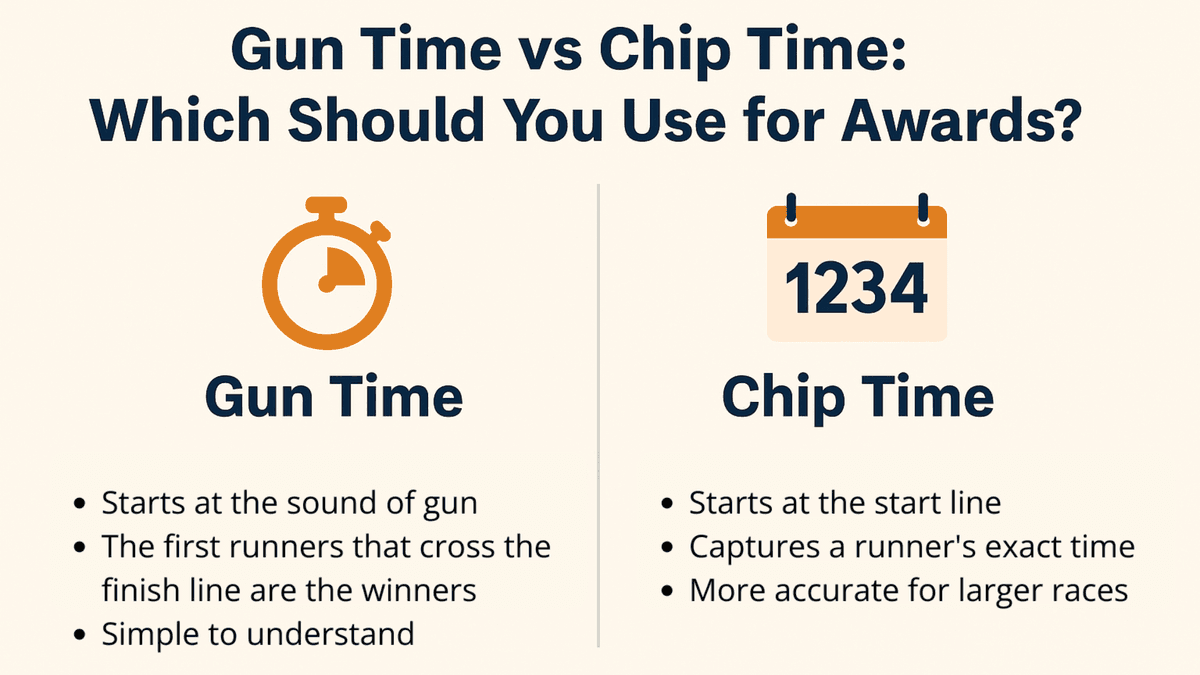
Gun time starts when the race officially begins. Chip time starts when you cross the starting line.
For runners, understanding the difference matters when you're looking at race results, personal records, or awards. For race directors, choosing how to use each time is an important part of the race timing setup.
This guide explains gun time vs chip time, what each one means, which time typically counts for awards, and when chip time is most useful.
If you're new to race timing, our guide to DIY vs. chip timing for 5K races explains the different timing approaches race organizers can use.
The easiest way to understand the difference is:
For example, imagine a race starts at 8:00 AM, but you're far enough back in the field that you don't cross the start line until 8:03 AM.
If you finish at 8:30 AM:
Your chip time measures the time you actually spent running from the start line to the finish line.
| Feature | Gun Time | Chip Time |
|---|---|---|
| Start time | When the race officially starts | When you cross the start line |
| Finish time | When you cross the finish line | When you cross the finish line |
| Also called | Official start/finish time | Net time |
| Best for | Overall competition and race winners | Personal results and performance |
| Most useful when | Runners start together | Starts are crowded or spread out |
Gun time is the amount of time between the official start of the race and when a runner crosses the finish line.
When the starter's gun, horn, or other official start signal goes off, the race clock begins for everyone.
For example: If the race starts at 8:00 AM and you finish at 8:30 AM, your gun time is 30 minutes.
It doesn't matter whether you crossed the starting line at 8:00:05 or 8:03:00. Your gun time is calculated from the official race start.
Gun time means that every runner receives the same official start time.
This is particularly important for competitive racing because the first runner to cross the finish line is the first runner to finish the race.
That's why gun time is commonly used when determining overall race winners.
Gun time keeps head-to-head competition straightforward.
If two runners are competing for first place, the winner is the runner who crosses the finish line first.
There is no need to account for when each athlete crossed the starting line.
Gun time is especially useful for:
Chip time, also known as net time, measures the amount of time between when a runner crosses the starting line and when they cross the finish line.
A timing chip attached to the runner's bib is detected by timing equipment at the start and finish.
For example:
The three-minute difference represents the time the runner spent waiting to reach the starting line.
Chip time is the time a runner actually spends on the course, from the start timing point to the finish timing point.
For runners starting toward the back of a large field, this can provide a more useful measure of individual performance.
That's particularly helpful when runners are tracking:
The difference occurs because runners don't all cross the starting line at the same moment.
In a small race with 100 runners and a wide starting line, the difference may be only a few seconds.
In a large race, it may take several minutes for everyone to cross the start.
For example: Race starts → Runner waits in the crowd → Runner crosses start → Runner finishes
Gun time includes the entire period from the official race start.
Chip time starts when the runner actually crosses the start timing point.
The larger and more crowded the starting field, the greater the potential difference between the two times.
There isn't one answer for every race.
The race organizer needs to establish the rules for how results and awards are calculated.
Gun time is commonly used for overall winners.
The reason is simple: road racing traditionally determines the winner by who reaches the finish line first after the official start.
This keeps head-to-head competition clear.
Chip time may be used for age-group results, depending on the race's rules.
Using chip time can help compare runners based on the amount of time they actually spent on the course, particularly when the starting field is large.
However, race-specific rules can differ, so organizers should clearly communicate which timing method applies to each award category.
For individual runners, chip time is often the number they care about most when evaluating their own performance.
If you're trying to determine how long it actually took you to run the course, chip time gives you that start-to-finish measurement.
Don't leave runners guessing.
Your race website, registration information, race instructions, and results should clearly explain:
You may also see gun time vs net time when looking at race results.
In most race-timing contexts:
So when you see chip time vs gun time, you're generally comparing the same two concepts as net time vs gun time.
The terminology can vary between races, so always check the event's official timing rules.
Another term runners may encounter is clock time.
The race clock typically starts when the race officially begins and continues throughout the event.
That makes clock time closely related to gun time when you're looking at the official race clock.
Chip time is different because it is based on the individual runner's crossing of the start and finish timing points.
For a runner who starts several minutes after the official start, the difference can be significant.
Gun time is a straightforward option when:
For a small race where everyone crosses the start line within a few seconds, the difference between gun time and chip time may be minimal.
Chip timing becomes particularly useful when:
Chip timing allows the system to record when each participant actually crosses the timing points.
For race directors comparing timing approaches, how much it costs to time a 5K can help with budgeting and understanding the factors that affect timing costs.
The process is relatively simple from the runner's perspective.
A typical RFID chip-timing workflow looks like this:
The timing equipment can also be used at split points to record intermediate times.
If you want to understand the technology behind this process, our guide to 5K race timing equipment explains how timing chips, mats, antennas, readers, and software work together.
Here's a simple example of how the two times can differ.
Imagine a 5K starts at 8:00 AM.
You are toward the back of the starting field and cross the start line at 8:02 AM.
You cross the finish line at 8:27 AM.
Your results would be:
| Timing Method | Result |
|---|---|
| Gun time | 27:00 |
| Chip time | 25:00 |
| Difference | 2:00 |
You spent 25 minutes running from the start line to the finish line, but your gun time includes the two minutes between the official start and when you crossed the starting line.
In a small race, gun time and chip time may be nearly identical.
If you cross the start line immediately after the official start, there isn't much time between the two measurements.
For example:
Your:
The difference is only three seconds.
Understanding gun time and chip time is only part of the timing process.
Race directors should also watch for common timing problems such as:
Clear communication is particularly important.
If runners don't know whether awards are based on gun time or chip time, even accurate results can lead to confusion.
Run The Day provides race registration and timing solutions for community races, schools, charity events, and other road races.
For events using professional chip timing, the timing workflow can connect participant registration, bib assignments, timing data, and race results.
Run The Day also offers a DIY Race Timing option for smaller races. The current DIY setup is designed for approximately 50–250 runners and uses a phone-based finish-line system rather than RFID timing mats and chips. It is a different approach from professional chip timing and is intended for races that fit that simpler format.
For larger or more complex events, professional chip timing can provide automated timing at the start, finish, and other timing points as needed.
Timing is only one part of preparing a successful race.
Before race day, you also need to plan registration, volunteers, sponsors, race materials, course logistics, timing, and participant communication.
Download our free Race Planning Checklist for a step-by-step guide to organizing your 5K and preparing for race day.
Gun time starts when the race officially begins and ends when the runner crosses the finish line. Every runner receives the same official start time regardless of when they cross the starting line.
Chip time measures the time from when a runner crosses the start timing point to when they cross the finish line. It is commonly also called net time.
Gun time starts when the race officially starts, while chip time starts when the individual runner crosses the start line. The difference is usually caused by the time it takes a runner to reach the start line.
Neither is universally better. Gun time is commonly used for determining overall race winners, while chip time is useful for measuring an individual runner's actual start-to-finish performance.
Chip time is commonly used by runners to evaluate their individual performance because it measures the time from their start-line crossing to their finish. However, official PR or qualification rules can vary by race or governing organization.
Gun time starts when the race begins. Net time starts when the individual runner crosses the starting line. Chip time is commonly used as another term for net time.
If you started behind the front of the field, your chip time may be faster because it doesn't include the time you spent waiting to cross the starting line.
Marathons can use both. Gun time is commonly important for overall competition, while chip or net time provides individual start-to-finish results. The exact rules for awards and official results depend on the event.
Gun time and chip time measure the same race from two different starting points.
Gun time starts when the race officially begins. Chip time starts when the individual runner crosses the starting line.
For competitive racing and overall winners, gun time is commonly the important measurement. For individual runners, especially in large and crowded races, chip time provides a better picture of the time they actually spent on the course.
The most important thing for race directors is to define the timing rules before race day and communicate them clearly to participants.